4-2-2024: Pots and vessels
"May our sons and grandsons safeguard and use this precious oblation vessel for tens of thousands of years."
There is no particular clue about such sempiternal statement quoted from the 1972 art exhibit (the material that is shared on the website).
It sounds like an Asian philosophical lesson, but, it is about objects, right? Oblation vessels are of the family of vessels and containers. Oblation is a thing presented or offered to God or a god.
Artgraphic-db proposes a meaning to the term "oblation vessel". An oblation vessel is a sacrificial object of type container, usually open (?, with no top), used to contain a thing presented to ... (???, god, Y_).
Artgraphic-db also mentions that this quote is from a paragraph of the catalogue referring to a section of the exhibit about the dragon used in western pottery (article title : The Dragon as a Decorative Motif in Far-Eastern and European Pottery around the Year 1900 )
Keywords: ceramic art; animal motif; floral tendencies so typical of art nouveau and the Jugendstil; iconographical dragon

This article is reproduced at the end of today's blog !!!!! GoTo
"Objected" here are pieces that have a function. Besides the value or the price of these objects, the question is why a functional object crossing time, and space, become such philosophical meaning vectors.
The Representation of Man in Asia and everywhere finally, has records about vessels. This is about memory also, though.
"For the Greeks, daily, for storage, carrying, mixing, serving, and drinking, and as cosmetic and perfume containers."
About the specific types of vessels called vases, artgraphic-db sends to the following online gallery. Specific collection also presenting "best-known Chinese porcelains in the world" the DAVID VASES.
https://www.mayfairgallery.com/blog/history-antique-vases/ : link
https://en.wikipedia.org/wiki/Percival_David_Foundation_of_Chinese_Art
https://en.wikipedia.org/wiki/David_Vases
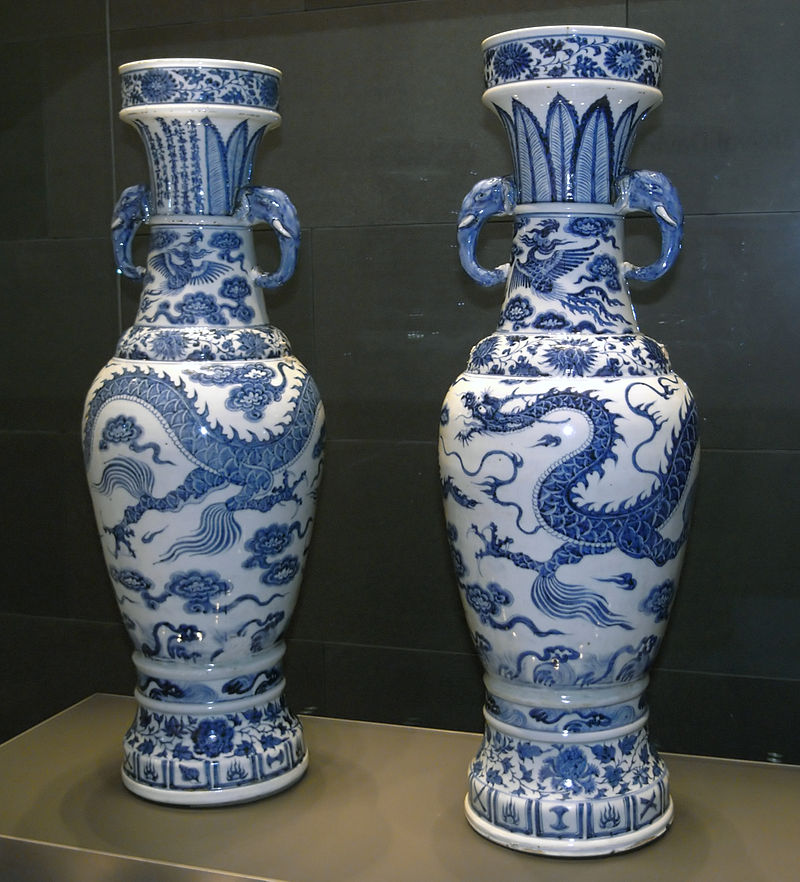
Is a vase a vessel?
(
To whom is interested the price/value of the DAVID VASES with reference to another vase (estimated $15,000 27 Feb 2024 $15,000)

A clue for understanding importance of these objects -say, pots, vessels, potteries- (are they?, some say yes, some of us say yes), proposed by Harvard museums (in a 2016 blog as part of the topic Prehistoric Pottery from Northwest China), from the archeological point of view, specialized to ancient Chinese vessels. In substance, the methods of making, the technology, or technological aspect can value, for the Representation of Man purpose (?), keeping in mind that "We have limited understanding about ancient pottery production".
https://harvardartmuseums.org/article/understanding-ancient-chinese-vessels: vessels
https://artsandculture.google.com/story/pots-vessels-and-the-philosophy-of-plentitude-mode/-gWBFN3kKhydJQ?hl=en IS A VERY GOOD INSIGHT ABOUT PHILOLOGICAL OF VESSELS AND CONTAINERS
other vessels

Insight: https://orientalantiques.co.uk/chinese-archaic-bronze-forms/

Pieces of vessels are also of interest (says https://americanindian.si.edu/collections-search/object/NMAI_26543)

Today's photographs referring to the Representation of Man by vessels and containers.
 mayfairgallery photographs about vessels and containers.
ARTICLE
The Dragon as a Decorative Motif in Far-Eastern and European Pottery around the Year 1900
Keywords: ceramic art; animal motif; floral tendencies so typical of art nouveau and the Jugendstil; iconographical dragon
"May our sons and grandsons safeguard and use this precious oblation vessel for tens of thousands of years." Inscriptions such as these show the value attached to the products of the potter's art. They were treated as cultic objects with an influence far beyond regional borders and with the power of uniting generations. They thus tell us about the way people lived and the course history took. And it is a fact that there are areas of the civilizations of the Far East that we can only elucidate and understand with the help of the forms the pottery took, with the help of those forms in fact which are often enough at the roots of innumerable European vessels. Their influence is felt in so many respects even today. If in the exhibition "World Cultures and Modern Art" this department is treated with particular care, then this is to be explained by the fact that only here the presentation of contrasted pairs and series is completely convincing. The encounter of the peoples of the world took place first of all on the basis of ceramic art. If the systematic presentation in the exhibition shows convincingly the influence of Asia, Africa and Amerindia in the realms of painting and sculpture, here in the pottery section the reception is all prevailing and has determined so great a part of the form and decoration for thousands of years right up to the present day.
This section in which the pottery of East and West is presented contrastively is only intended to provide a stimulus; so inexhaustible is the interaction that the treatment cannot be exhaustive. The plastic overlays on vessels come first in the section: they are intended to provide the uninitiated with an overall view. However, priority is given to Chinese forms which have, via Japan, exercised a decisive influence on European pottery. In describing individual vessels, the decoration is often the prime consideration. The dragon motif is here of particular significance. The very form of the animal- its long tail, its claws, the fantastic head, its wide-open jaws, its long tongue - predestined it as a decorative motif. And vessels thus ornamented could hardly escape the notice of the western artist because of their bizarre form. Very soon French, English and German potters were trying to grasp the real significance of this form and then to assimilate it.
French ceramists reached the heights here around the year 1900. In them we can recognize the Far-Eastern influence, but at the same time we see that they managed to attain an independent, personal style of their own. Of course, the floral tendencies so typical of art nouveau and the Jugendstil more than met them half way in their attempts to absorb the dragon motif. During this period it led artists to seek their decorative inspiration in other members of the zoological realm, too. The iconographical significance of the dragon is misunderstood and we find it being transformed into salamanders, snakes and various forms of amphibians on art nouveau glassware.
S.W.
Summary and Translation P. J. D.


https://chaohanoi.com/wp-content/uploads/2019/03/scent_of_green_papaya_vietnam-2-1024x576.jpg
ReplyDeletesacrificial, ritual vessels are said as offertory
ReplyDelete